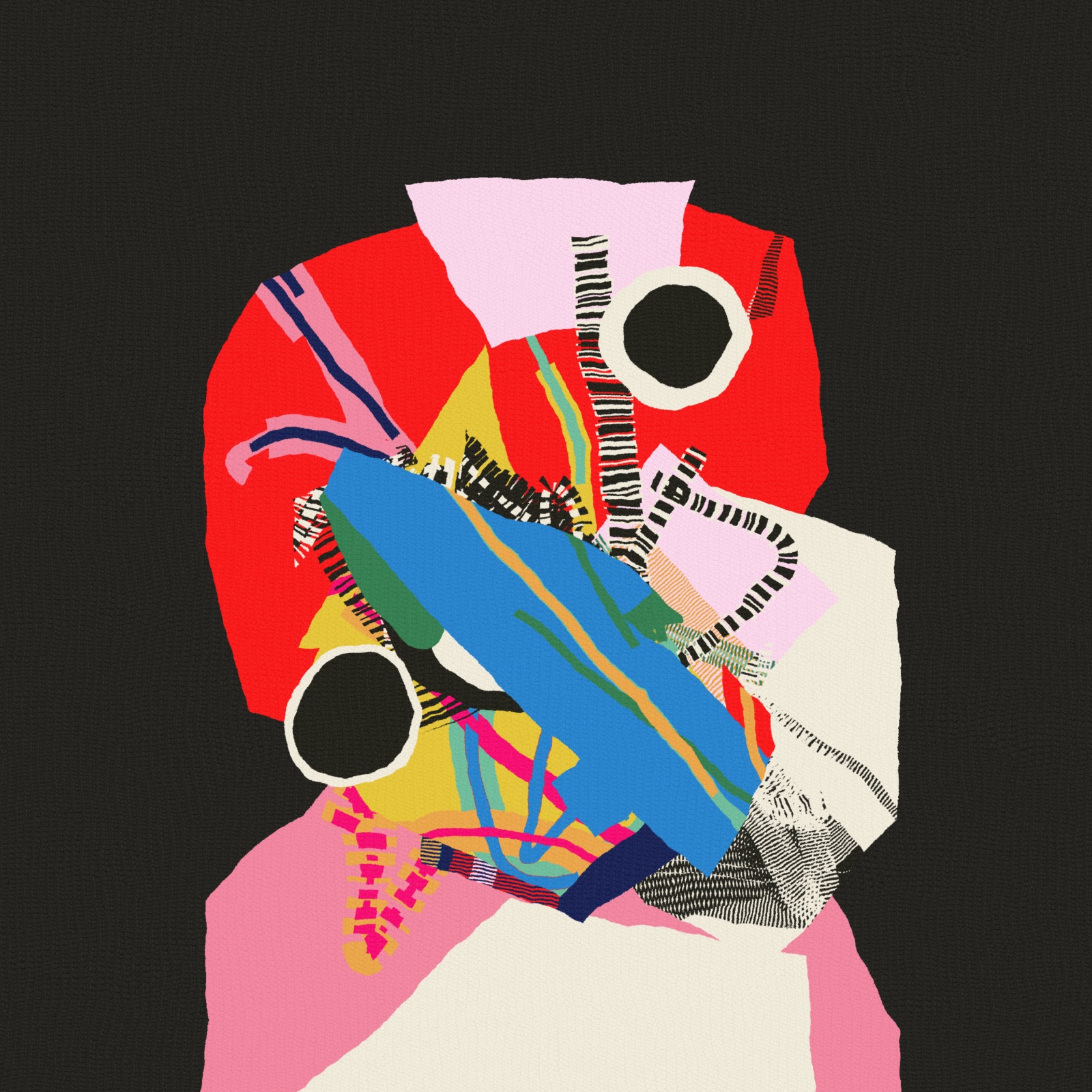
Ty Vek
//
THE FLOOD &
THE WHALE
Explore Collection →
Launch playground →
View on fxhash →
← Return to portfolio
March 10, 2026. 10am PT on fxhash.
The Flood & The Whale is a relative to Inner Forms; a playful take on a violent archetype and a transformative symbol.
Where Inner Forms was an open-form project abstracting Jung's ideas on archetypes and the collective unconscious, The Flood & The Whale focuses on some more concrete motifs that can manifest in myths, visions and dreams—namely, floods and whales.
Initially, this collection was going to be the next "Act" of Inner Forms, utilizing the ability of open-form projects to have their codebase updated, but as I worked on it, the less and less it seemed like a piece of that project, and more like something that would stand outside—or at least next to—that collection.
I also wanted more control over the final outputs, and releasing it as long-form with curated outputs would allow that. More on how this project is curated will be discussed in a later section.

"I saw a terrible flood that covered all the northern and low-lying lands between the North Sea and the Alps. It reached from England up to Russia, and from the coast of the North Sea right up to the Alps. I saw yellow waves, swimming rubble, and the death of countless thousands. Then the whole sea turned to blood."
— C.G. Jung, Liber Novus.
The above quote comes from 1913.
Two weeks after that initial vision, it returned, more vividly and with a greater emphasis on blood. Yikes.
This was shortly after his break with Freud and during a time where he felt an intense state of disorientation.
Once The Great War began—which was very soon after—Jung identified these visions as premonitions of that war... and along with it, fascism and societal change. Clearly it was a fun time in his life.

While Jung doesn't really talk much of whales directly, if at all, they are a common archetype... whether in dreams or more formally in Joseph Campbell's version of the Hero's Journey.
Campbell uses the belly of the whale to illustrate the willingness to cross the last threshold, or departure of self; ego death, or something like it.
The eventual hero is swallowed into the unknown, and for all purposes... dies. This is the end of the first Act in the journey called Departure, followed by Initiation and ultimately, Return.
Being in the belly—or allusions to it—are a popular motif of self-annihilation or letting go of control. For Jonah, it was submitting to God's will. Star Wars' trash compactor scene in the belly of the Death Star was George Lucas's version of this. Let's not forget about Geppetto and Pinocchio ending up in belly of the same whale.
So, again, while Jung never talked about whales explicitly, he did explore the concept of katabasis, which refers to the vital descent into the unconscious, the "underworld" of the psyche; a necessary journey for psychological growth, individuation, and confronting one's shadow.

Even without being vehicles for the rebirth of others, whales in and of themselves can represent wisdom, emotional depth and spiritual awakening.
Their perceived wisdom and longevity connect them to deep ancestral knowledge, conceivably.
The mere act of rising to the oceans surface from deep to breach and emerge from the water repeats this idea of rebirth.

Floods in dreams and myths are often representative of chaos and destruction, sure, but also the rebirth and creation that follows.
Things can get worse before they get better and that's what this project is leaning into a bit, but take from it what you like. In a lot of ways, it's just going to be happy little whales playing. Forget the desparate arms of the drowning people.
The flood will pass. Not everything will die. After things are cleared, then there is room to grow again.
That's kind of the point of the whole Hero's Journey, right? You have to die—figuratively, at least—to keep your old self from holding you back from being a fully realized you.

The way this project echoes Inner Forms is in the way it can show evolution. Instead of opening this up with the open-form mechanic which pushes collectors to explore and find generations and lineages, this project contains curated sets from related lineages.
It does this so there are sets of outputs that are related that tell something like a story, or at least, a progression. Some might be 4 outputs long, some 20.
They might (and almost certainly will) be skipping generations in effort to reduce redundant expressions or steps along the way. They will be randomized during the mint.
Just like Inner Forms, though, many lineages/stories will start very simple... maybe just a few drops falling or a single wave or a rising tide, only to evolve to complex and layered compositions that have unexpected emergent interplay of elements.

Press "I" to toggle the info card.
Press "G" to save a GIF.
Press "B" to save a bigger GIF. (If you specified a custom height, etc.)
Press "J" to save a JPG at current size.
Press "R" to render high-resolution JPG.

Add some combination of these to the url to customize the outputs. Some combinations cancel others and who knows, could break the output. Use your best judgement.
&static=true : Only render one frame (useful for rendering large images for prints) &height=X : draw images at X height (width will be calculated)
&aspect=X : override the aspect ratio (width / height; 0.5 will be twice as tall)
&square=true : aspect ratio of composition remains the same, but full image will be padded out so the image is a square
&saveframes=true : Save each frame of GIF locally as it renders
&gframes=X : Render GIF with X frames (default: 5)
&gdelay=X : Render GIF with X milliseconds between frames (default: 100)
&gheight=X : Render GIF with X height (default: 2000)
&grain=X : grain level (default: 1, higher is more grain, 0 is none)
&ff=true : "force fabric" — Safari was slow rendering the texture, so by default it doesn't get all the texture rendered in Chrome, use this to override.

The Flood & The Whale is written in vanilla Javascript, composed as SVG and then rendered to a 2d canvas. It is then processed a little bit.
There might be slight differences in rendering from browser to browser. This is expected as they might translate the SVG slightly differently. Let's call Chromium renderings canonical. They also render faster there and we love that.
Shoutout to Matt DesLauriers for A) being an incredible artist, and B) for writing gifenc, a wonderful GIF encoder for Javascript that was used in this project.